Challenge. Success

We develop infrastructures and provide services to improve people’s lives.

SEE MORE

Celebramos 40 años de historia

Prueba texto 40 aniversario

sustainability

Sustainable concessions

Our projects’ environmental and social sustainability holds a central position within the framework of the 2021-2025 Strategic Plan.

INTERNATIONAL

We are a global group that grows with you

We are present in more than 20 countries and we have a diversified portfolio

ENVIRONMENTAL

We are #GenerationRestoration

At Sacyr, we believe that conserving and making sustainable use of biodiversity is key to our progress.

ENGINEERING

Growth in the US

Sacyr develops road infrastructure in Florida and Texas. In the latter, we are expanding the interstate IH35E.

Sports

Sacyr DNA

We promote sporting values and healthy lifestyle habits both inside and outside the company

Categorization
Categorization
Categorization
Categorization
Categorization
Categorization
Categorization
Categorization


Sin perder de vista el presente afrontamos los nuevos retos con ilusión;impulsando el crecimiento de Sacyr y el de todas las personas que hacen posible que la compañía siga encaminada en una misma dirección


Manuel Manrique Cecilia

Presidente y Consejero Delegado


En Sacyr contribuimos a mejorar la calidad de vida de las personas en las comunidades donde estamos presentes, mediante el desarrollo de nuestras actividades, lo que nos permite desempeñar un papel fundamental en la construcción de una sociedad más equitativa y sostenible.


Nuestras prácticas en materia de gobierno corporativo están dirigidas a garantizar la adecuada administración de la compañía, a garantizar la involucración y el ejercicio de los derechos de todos los accionistas y a informar con la máxima transparencia sobre el funcionamiento y la situación económica.


En Sacyr, estamos convencidos de que el crecimiento sostenible sólo es posible apostando por la preservación del planeta. Por este motivo desarrollamos nuestras actividades atendiendo a una gestión responsable de las materias primas, los residuos y los recursos energéticos, en armonía con la naturaleza.


En Sacyr apostamos por el concepto de Seguridad Integrada y, para  ello, contamos con una Política de Seguridad y Salud en el Trabajo que ha sido revisada en 2022 y cuyo objetivo es promover la mejora de las condiciones de trabajo y el nivel de protección, seguridad y salud de nuestros trabajadores.


Comprometidos a afrontar cualquier reto para transformar nuestra sociedad y mejorar la vida de las personas.

  • Science talks

Orange peels to produce biofuel 

The need to manage waste and its valuation raises the opportunity for promising environmental projects, like FUELCAM, by the Universidad Politécnica de Madrid and the Universidad de Castilla la Mancha, focused on the use of hydrogenated terpenes.

The need to manage waste and its valuation raises the opportunity for promising environmental projects, like FUELCAM, by the Universidad Politécnica de Madrid and the Universidad de Castilla la Mancha, focused on the use of hydrogenated terpenes to create biofuel from orange peels or pine tree resin.

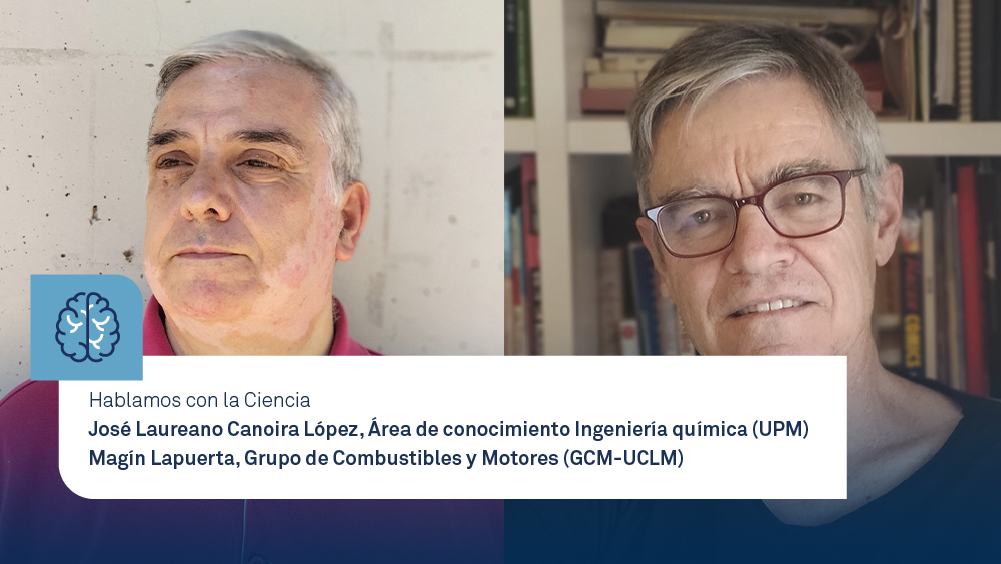
“This project originated five years ago to revalorize waste in the Castilla La Mancha region”, explains Magín Lapuerta, a professor at the Universidad de Castilla – La Mancha, where he coordinates the Grupo de Combustibles y Motores (GCM-UCLM) and assesses the Committee for the European norms on fuel. 

“The first part of this job involved working with turpentine, a terpene distilled from pine tree resin, that is after subject to hydrogenation, so that it won’t produce black smoke at combustion”, explains Lapuerta.
Then, it was the turn for orange peels, a readily available material since it is a byproduct that is not used by coopearatives and farmers. 

This project stems from David Donoso’s thesis. David is a researcher at the ETS de Ingeniería Industrial de la UCLM, that comprises three research lines with three different raw materials, the three of them terpenos hidrogenados: turpentine, hydrogenated orange oil and CST, which is sulfate turpentine, a paper industry byproduct.

“Our research confirms that fully hydrogenating fuel allows to reduce soot by 55%”, says David Donoso.


Turpentine isn’t really a byproduct. It’s extracted from pine trees, and it’s mainly used to produce substances like turpentine spirits. While its extraction would have major impact on the pine tree industry and have applications to prevent fires, this research line doesn’t show much promise.

For that reason, they focused on CST and orange peels. “The research to create fuel was done with a reactor at the Universidad Politécnica de Madrid. We created enough to burn it with an engine”, explains Lapuerta.

The fuel was tested at Castilla La Mancha mixed with diesel fuel.  In the test formulas, 20% is hydogenated turpentine or hydrogenated orange oil, and 80% is diesel. 

 “The percentage of biofuel could be raised. We give added value with the hydrogenation”, researchers say. It could also be tested in gas engines. 

“Now we need to take the leap on an industrial scale, by testing biofuels mixed with JetA1 in aircraft turbines”, explains José Laureano Canoira López, professor at the Chemical engineering area of the Universidad Politécnica de Madrid (UPM).


“We still need to find turbines to test out these results in the aviation industry. We need a refinery or biorefinery company willing to hydrogenate the materials for us and prepare a large amount to start testing on real planes”, researchers say.

However, there is a major gap that seems tough to close. In order to test out efficiently they would need to produce at least 100 liters, but for fuel companies to find the operation profitable, they would need to produce at least 1,000 liters and take the risk.

The  ASTM (American Society for Testing and Materials) lays down the possibility of using from 10% to 50% of biofuels in aviation, as long as they meet the requirements.

There are other research lines with potential. There are other types of terpene waste, such as biowaste from parks and gardens maintenance, mostly leaves, which could also be used to make biofuels. 
  • Biofuel

This website uses its own and third-party cookies to improve the user experience and analyze their behavior in order to improve the service offered.
You can consult additional information about the cookies installed on our Cookies policy.

Cookie Settings

Cookie declaration

TECHNIQUES

These cookies are exempt from compliance with article 22.2 of the LSSI in accordance with the recommendations indicated by the European authority on privacy and cookies. In accordance with the above and although configuration, acceptance or denial is not possible, the editor of this website offers information about them in an exercise of transparency with the user.

  • Name: LFR_Session_STATE_*, Provider: Liferay, Purpose: Manages the session as a registered user , Expiration: Session, Type: HTTP

  • Name: GUEST_LANGUAGE_ID, Provider: Liferay, Purpose: Determines the language with which you access , to show the same in the next session, Expiration: 1 year, Type: HTTP

  • Name: ANONYMOUS_USER_ID, Provider: Liferay, Purpose: Manages the session as an unregistered user , Expiration: 1 year, Type: HTTP

  • Name: COOKIE_SUPPORT, Provider: Liferay, Purpose: Identifies that the use of cookies for the operation of the portal, Expiration: 1 year, Type: HTTP

  • Name: JSessionID, Provider: Liferay, Purpose: Manages login and indicates who is using the site, Expiry: Session, Type: HTTP

  • Name: SACYRGDPR, Supplier: Sacyr, Purpose: Used to manage the cookie policy , Expiration: Session, Type: HTTP